


 PDF Version Demo
The Databricks Certified Machine Learning Associate exam has a reputation for breadth, and many candidates underestimate how much ground it covers. Getcertkey closes those gaps with 76 practice questions that reflect the style and difficulty you can expect in 2026.
Databricks Databricks-Machine-Learning-Associate Exam Overview:
| Certification Vendor: | Databricks |
|---|---|
| Exam Name: | Databricks Certified Machine Learning Associate Exam |
| Exam Number: | Databricks-Machine-Learning-Associate |
| Exam Price: | USD 200 (plus applicable taxes) |
| Exam Format: | Multiple-choice, Multiple-selection |
| Available Languages: | Portuguese (Brazil), Korean, Japanese, English |
| Related Certifications: | Databricks Certified Data Analyst Associate Databricks Certified Data Engineer Associate |
| Certificate Validity Period: | 2 years |
| Passing Score: | Not publicly disclosed |
| Exam Duration: | 90 minutes |
| Real Exam Qty: | 48 |
| Recommended Training: | Databricks Academy Machine Learning with Databricks |
| Exam Registration: | Official Registration |
| Sample Questions: |  |
| Exam Way: | Online proctored or in-person at authorized test centers |
| Pre Condition: | No formal prerequisites; 6+ months hands-on Databricks ML experience recommended |
| Official Syllabus URL: | https://www.databricks.com/learn/certification/machine-learning-associate |
Databricks Databricks-Machine-Learning-Associate Exam Syllabus Topics:
| Section | Weight | Objectives |
|---|---|---|
| Topic 1: Model Development | 31% | - Training, Tuning and Evaluation
|
| Topic 2: Model Deployment | 12% | - Model Registry and Serving
|
| Topic 3: ML Workflows | 19% | - MLflow Tracking and Experimentation
|
| Topic 4: Databricks Machine Learning | 38% | - Databricks ML Environment and Capabilities
|
Databricks-Machine-Learning-Associate Exam FAQs for 2026 Candidates
Which certification does the Databricks-Machine-Learning-Associate exam lead to?
The Databricks-Machine-Learning-Associate exam is the official Databricks exam behind the Databricks Certified Machine Learning Associate certification, validating the skills measured by the Databricks Certified Machine Learning Associate credential. It sits at the Associate level of the Databricks certification program. It also connects to Databricks Certified Data Analyst Associate, Databricks Certified Data Engineer Associate, so the knowledge you build here carries over to those tracks as well.
How many questions are on the Databricks-Machine-Learning-Associate exam, and how much time do I get?
The Databricks-Machine-Learning-Associate exam contains 48 questions to be completed within 90 minutes. Before exam day, divide the available time by the question count to work out a comfortable per-question pace, and mark any item that eats into it so you can return later instead of getting stuck. Timed sessions in the Getcertkey test engines make that pacing automatic — run at least two full-length mock exams under the clock so time pressure never becomes the reason you drop points.
What score do I need to pass the Databricks-Machine-Learning-Associate exam, and what does it cost?
The passing score for the Databricks-Machine-Learning-Associate exam is Not publicly disclosed, and the official registration fee is USD 200 (plus applicable taxes). Retakes are not discounted — every new attempt means paying the full fee again — so it pays to measure yourself before you book. Work through the 76 practice questions on Getcertkey, sit a timed practice test, and schedule your exam only when your scores are consistently comfortable. That simple habit is the cheapest exam strategy there is.
Are there any prerequisites for the Databricks-Machine-Learning-Associate exam?
No formal prerequisites; 6+ months hands-on Databricks ML experience recommended Requirements can change when Databricks revises its certification program, so confirm the current eligibility rules on the official exam page before you register.
How do I register for the Databricks-Machine-Learning-Associate exam?
You can book the Databricks Certified Machine Learning Associate exam through the official registration channels below:
As for delivery, the exam is offered in the following format: Online proctored or in-person at authorized test centers. Choose the option that suits you best when you book your seat.
What official training is recommended for the Databricks-Machine-Learning-Associate exam?
Databricks recommends the following training resources for the Databricks Certified Machine Learning Associate exam:
Official courses build the foundation; the 76 practice questions from Getcertkey then show you how that knowledge is examined, so the two work best together.
Can I try the Databricks-Machine-Learning-Associate practice questions before I buy?
Yes. Getcertkey provides a free Databricks-Machine-Learning-Associate PDF demo so you can review the question style and answer quality before purchasing. Every purchase also includes 365 days of free updates — if Databricks revises the exam during that period, the updated material reaches you at no cost. Once the free-update year ends, you can extend your update service at a 50% discount.
What if I fail the Databricks-Machine-Learning-Associate exam, and how is my order delivered?
Every Databricks Certified Machine Learning Associate purchase on Getcertkey is covered by a 100% money-back guarantee with clear conditions: if you take the corresponding exam within 60 days of your purchase and do not pass, you can claim a full refund by submitting a scanned copy of your exam enrollment slip and your official score report as a PDF within two days of the exam date; claims are processed within seven days of submission. The guarantee does not apply to exams taken within three days of purchase, to material that was downloaded but never used in an exam attempt, or to free products and expired orders, and the candidate name must match the payer name. If you would rather not take a refund, you can instead exchange your purchase for two free exam preparation products of equal value and keep the update service on your original product.
Delivery is instant: your download is sent to your email within one minute of payment, with no limit on how many computers you may install the material on. If nothing arrives within two hours, check your spam folder and contact customer service for help.
What topics are covered in the Databricks-Machine-Learning-Associate exam?
The Databricks Certified Machine Learning Associate exam blueprint is organized into 4 domains. The first three are:
- Databricks Machine Learning — 38% of the exam
- ML Workflows — 19% of the exam
- Model Development — 31% of the exam
For the complete domain-by-domain breakdown, scroll up to the full exam topics outline above and use it to plan how you distribute your study time.
Databricks Certified Machine Learning Associate Sample Questions:
Question 1
A data scientist learned during their training to always use 5-fold cross-validation in their model development workflow. A colleague suggests that there are cases where a train-validation split could be preferred over k-fold cross-validation when k > 2.
Which of the following describes a potential benefit of using a train-validation split over k-fold cross-validation in this scenario?
A. Reproducibility is achievable when using a train-validation split
B. A holdout set is not necessary when using a train-validation split
C. Fewer hyperparameter values need to be tested when using a train-validation split
D. Bias is avoidable when using a train-validation split
E. Fewer models need to be trained when using a train-validation split
Question 2
Which of the following describes the relationship between native Spark DataFrames and pandas API on Spark DataFrames?
A. pandas API on Spark DataFrames are more performant than Spark DataFrames
B. pandas API on Spark DataFrames are single-node versions of Spark DataFrames with additional metadata
C. pandas API on Spark DataFrames are made up of Spark DataFrames and additional metadata
D. pandas API on Spark DataFrames are less mutable versions of Spark DataFrames
Question 3
A data scientist is performing hyperparameter tuning using an iterative optimization algorithm. Each evaluation of unique hyperparameter values is being trained on a single compute node. They are performing eight total evaluations across eight total compute nodes. While the accuracy of the model does vary over the eight evaluations, they notice there is no trend of improvement in the accuracy. The data scientist believes this is due to the parallelization of the tuning process.
Which change could the data scientist make to improve their model accuracy over the course of their tuning process?
A. Change the number of compute nodes and the number of evaluations to be much larger but equal.
B. Change the iterative optimization algorithm used to facilitate the tuning process.
C. Change the number of compute nodes to be half or less than half of the number of evaluations.
D. Change the number of compute nodes to be double or more than double the number of evaluations.
Question 4
A data scientist has developed a random forest regressor rfr and included it as the final stage in a Spark MLPipeline pipeline. They then set up a cross-validation process with pipeline as the estimator in the following code block: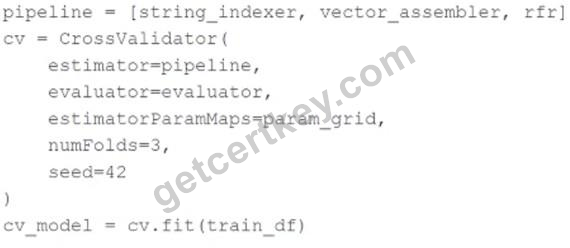
Which of the following is a negative consequence of including pipeline as the estimator in the cross-validation process rather than rfr as the estimator?
A. The process will have a longer runtime because all stages of pipeline need to be refit or retransformed with each mode
B. The process will leak data prep information from the validation sets to the training sets for each model
C. The process will leak data from the training set to the test set during the evaluation phase
D. The process will be unable to parallelize tuning due to the distributed nature of pipeline
Question 5
A data scientist has written a data cleaning notebook that utilizes the pandas library, but their colleague has suggested that they refactor their notebook to scale with big data.
Which of the following approaches can the data scientist take to spend the least amount of time refactoring their notebook to scale with big data?
A. They can refactor their notebook to utilize the pandas API on Spark.
B. They can refactor their notebook to process the data in parallel.
C. They can refactor their notebook to use the Scala Dataset API.
D. They can refactor their notebook to use Spark SQL.
E. They can refactor their notebook to use the PySpark DataFrame API.
Solutions:
| Question 1 Answer: E | Question 2 Answer: C | Question 3 Answer: B | Question 4 Answer: A | Question 5 Answer: A |
 787 Customer Reviews


 Quality and ValueGetCertKey Practice Exams are written to the highest standards of technical accuracy, using only certified subject matter experts and published authors for development - no all study materials.
 Tested and ApprovedWe are committed to the process of vendor and third party approvals. We believe professionals and executives alike deserve the confidence of quality coverage these authorizations provide.
 Easy to PassIf you prepare for the exams using our GetCertKey testing engine, It is easy to succeed for all certifications in the first attempt. You don't have to deal with all dumps or any free torrent / rapidshare all stuff.
 Try Before BuyGetCertKey offers free demo of each product. You can check out the interface, question quality and usability of our practice exams before you decide to buy.